Table of Contents
Strategic Kitchen Illumination Architecture in San Fernando Valley Homes
We design kitchen lighting systems across Encino and surrounding San Fernando Valley communities by balancing regulatory efficiency with architectural depth. Prioritizing intentionally layered fixtures over single-source ceiling lights ensures complete visual clarity, eliminates working shadows on food prep surfaces, and creates adaptable light scenes for daytime prep and evening entertainment.
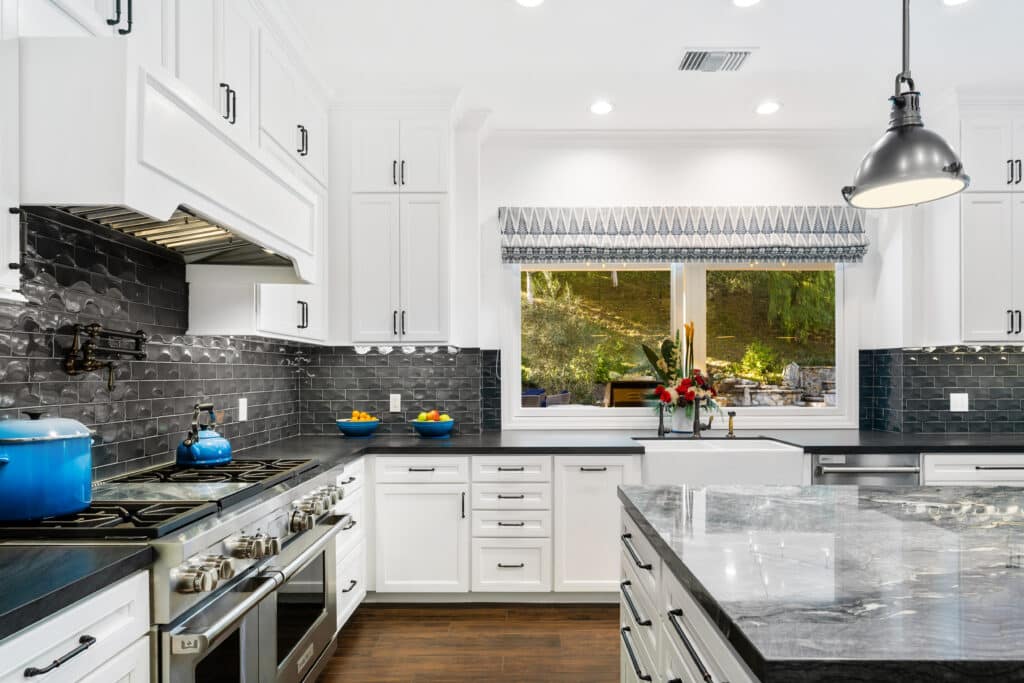
During our custom kitchen renovations in Sherman Oaks, Encino, and Tarzana, we consistently treat lighting as an integral structural system rather than an interior design afterthought. High-end finishes like quartzite countertops, custom walnut cabinetry, and porcelain tile backsplashes lose their visual impact when illuminated by improper beam spreads or harsh color temperatures.
By analyzing architectural room boundaries, natural daylight exposure, and surface reflectance before running rough-in electrical lines, we build illumination plans that elevate everyday functionality. Our comprehensive approach ensures that every workstation receives tailored lumen output while maintaining strict compliance with Southern California energy codes.
Structural Flaws of Single-Source Overhead Illumination
Single-source kitchen lighting fails because an overhead central fixture places the light source directly behind the home cook, projecting their body’s shadow across perimeter countertops. This geometric barrier starves prep zones of essential foot-candles, creating hazardous conditions for precise knife work, recipe reading, and appliance operation.
From an optical physics perspective, light originating from a solitary ceiling fixture overhead hits the cook’s back and head first. As a result, the primary surface where raw ingredients are handled remains cast in deep ambient shadow.
When homeowners attempt to solve this deficit by simply increasing the wattage of a central flush-mount or installing a simple symmetrical grid of recessed cans, they produce intense floor glare and ceiling hot spots. Effective light distribution requires positioning luminaires between the user and the working surface, supplemented by secondary layers that diffuse shadows across multiple incident angles.
The Three-Tier Tactical Lighting Framework
Our three-tier lighting framework integrates ambient baseline illumination, focused task light, and subtle accent fixtures into distinct electrical circuits. Separating these three layers allows homeowners to transition seamlessly from high-visibility culinary preparation to warm, atmospheric evening illumination while complying with strict California residential building codes.
Ambient Layer: Ceiling-Level Visual Baseline
Ambient lighting provides general room visibility and safe traffic flow throughout the kitchen space without producing harsh overhead glare. According to Illuminating Engineering Society (IES) standards, general kitchen circulation zones require a consistent horizontal illuminance target of 30 to 50 foot-candles measured at floor level.
In modern open-concept Valley floor plans, we deliver ambient light using quiet ceiling layouts composed of architectural recessed downlights or perimeter perimeter slot channels. We carefully select beam angles ranging from 38 to 60 degrees to cast uniform illumination across walk zones while avoiding overlapping hotspots.
Task Layer: Dedicated Prep and Workstation Lumens
Task lighting delivers direct, unshadowed illumination precisely onto high-activity culinary zones including perimeter countertops, kitchen islands, ranges, and sinks. The Illuminating Engineering Society (IES) recommends 50 to 100 foot-candles for active kitchen prep tasks, requiring hardwired under-cabinet fixtures and focused downlights calibrated to prevent visual fatigue.
- Under-Cabinet Linear LEDs: Continuous extruded aluminum channels fitted with frosted diffusers eliminate point-source reflection on counter surfaces while delivering high-density output.
- Island Pendant Arrays: Decorative hanging luminaires direct focused downlight over central preparation counters while serving as visual focal points across open living areas.
- Dedicated Workstation Downlights: Directly targeted directional downlights mounted above the main sink and cooktop ensure maximum visual clarity during food preparation and cleaning.
Accent Layer: Architectural Depth and Nighttime Transitions
Accent lighting creates visual dimension, highlights custom cabinetry details, and offers low-glare nighttime illumination throughout the open-concept footprint. By embedding low-voltage LED linear elements inside toe-kicks, display cabinets, and architectural coves, we define the room’s boundary without adding heat or consuming excessive energy during off-peak hours.
- Cabinet Toe-Kick LED Channels: Concealed low-voltage strip lighting along base cabinets projects a soft wash across the floor, providing safe nighttime navigation.
- Glass Cabinet Interior Displays: In-cabinet pucks or vertical ribbon channels accentuate fine glassware and decorative tile backings, turning storage zones into illuminated features.
- Over-Cabinet Cove Lighting: Upward-directed linear LED tape reflects light off ceiling planes, softening structural boundaries and making eight-foot ceiling spans feel significantly taller.
Exact Placement Formulas for Recessed Downlights and Island Pendants
Correct fixture spacing relies on strict geometric ratios tied to counter dimensions, ceiling heights, and eye-level sightlines across open floor plans. Proper mathematical placement prevents ceiling clutter, ensures even lumen dispersion across working surfaces, and maintains unobstructed views between the kitchen, dining, and adjacent living spaces.
- Determine perimeter recessed downlight setback by placing fixture centers 24 to 26 inches away from finished drywall walls so light casts directly over cabinet front edges.
- Space perimeter downlights apart by calculating half the total ceiling height, resulting in four-foot spacing for eight-foot ceilings and five-foot spacing for ten-foot ceilings.
- Establish island pendant hanging elevation by positioning fixture bases 30 to 36 inches above finished countertop surfaces to preserve sightlines while avoiding glare.
- Calculate pendant horizontal spacing by dividing total island length in inches by the desired number of pendants plus one, placing fixtures equal distances apart and from island ends.
California Title 24 Energy Standards and JA8 Regulatory Compliance
Residential kitchen renovations in Encino must satisfy Title 24, Part 6 requirements enforced by the California Energy Commission Title 24 standards. The code mandates that all fixed luminaires feature high-efficacy Joint Appendix 8 (JA8) certification, minimum 90 Color Rendering Index (CRI) output, and independent switch controls across functional zones.
To meet these legal benchmarks during a renovation, every permanent lighting fixture must carry factory JA8 labeling and demonstrate high efficacy performance under state testing protocols. Additionally, dimmer controls or automated vacancy sensors are required across residential circuits to ensure operational efficiency.
We prevent inspection delays with the City of Los Angeles Department of Building and Safety by engineering separate circuit control banks during electrical rough-in phases. If a client selects custom statement pendants lacking integrated JA8 LEDs, we install dedicated high-efficacy JA8-certified LED lamp bulbs inside standard socket housings to ensure full legal compliance.
Field Case Studies: Resolving Complex San Fernando Valley Lighting Challenges
Complex structural obstructions and high-glare stone surfaces frequently complicate high-end kitchen remodels across Encino and nearby Valley neighborhoods. We resolve these engineering bottlenecks through tailored hardware substitutions, low-profile architectural fixture integration, and multi-zone dimming controls that preserve aesthetic goals while meeting strict municipal inspection codes.
Low-Clearance Joist Abatement in a Mid-Century Encino Residence
Shallow roof joists in a South Encino mid-century home prevented the installation of standard recessed downlight housings during a full kitchen remodel. We resolved this clearance obstacle by specifying ultra-slim LED wafer fixtures coupled with hardwired under-cabinet linear extrusions to deliver full Title 24-compliant task illumination.
The original ceiling cavity contained tight two-by-six structural framing packed with rigid HVAC ducts and copper plumbing lines, leaving less than two inches of usable vertical clearance. Traditional five-inch recessed housing cans would have required dropping the entire drywall ceiling plane by four inches, reducing room volume.
We re-engineered the ceiling layout using low-profile LED disc lights requiring only one-half inch of vertical mounting depth. We paired these flush units with high-output 95 CRI under-cabinet linear channels, delivering 70 foot-candles of direct work surface light while keeping the original architectural ceiling height fully intact.
Multi-Surface Glare Mitigation on a Ventura Boulevard Estate
High-lumen 4000K downlights installed over a polished quartzite island created extreme glare and visual strain in an open-concept Ventura Boulevard residence. We corrected this reflection hazard by shifting to warm 2700K color temperatures, installing deep-regressed anti-glare baffled downlights, and implementing multi-zone smart dimming drivers.
The client’s expansive fourteen-foot polished quartzite island acted like a mirror, bouncing wide-angle downlight output directly into adjacent living and dining spaces. This reflection produced uncomfortable visual glare and washed out the warm natural tones of custom rift-sawn oak cabinetry.
We swapped out wide-beam light engines for deep-regressed architectural downlights fitted with dark internal glare baffles that hide the light source from horizontal view angles. By transitioning the system to 2700K warm-spectrum dimming circuits, we eliminated stone surface reflections while enhancing the natural gold veining of the quartzite counter.
Technical Specification Comparison for Kitchen Fixture Types
Evaluating kitchen light fixtures requires comparing primary applications, foot-candle output, state code compliance notes, and estimated total installation costs. Choosing the correct fixture for each functional layer ensures optimal visual ergonomics, long-term operational durability, and smooth compliance with City of Los Angeles Department of Building and Safety inspections.
| Fixture Type | Primary Application | Target Light Output (Foot-Candles) | California Title 24 Compliance Note | Estimated Cost Range |
|---|---|---|---|---|
| Architectural Recessed LED Downlights | General room ambient & perimeter coverage | 30 to 50 FC | Must be JA8 certified with high-efficacy drivers | 50 USD to 150 USD per fixture installed |
| Decorative Island Pendants | Workstation task light & visual focal point | 50 to 75 FC | Requires integrated JA8 LEDs or certified bulbs | 150 USD to 600 USD per fixture |
| Hardwired Under-Cabinet LED Channels | Direct perimeter countertop prep light | 50 to 100 FC | Must feature minimum 90 CRI and hardwired driver | 100 USD to 300 USD per run |
| Low-Voltage Linear Accent Channels | Toe-kick, architectural cove, interior cabinet | 10 to 20 FC | Transformers must meet state efficiency mandates | 200 USD to 500 USD per section |
| Architectural Feature Chandeliers | Dinette seating & double-height coves | 20 to 40 FC | Requires independent dimmable control zone | 300 USD to 1500 USD per fixture |
Failure Modes and Remodeling Mistakes to Avoid
Common kitchen lighting mistakes stem from improper fixture positioning, uncoordinated light color temperatures, and delayed electrical rough-in planning. Avoiding these systemic failures requires early load mapping, strict adherence to color rendering standards, and dedicated dimming control integration across every functional lighting layer in the layout.
- Unaligned Ceiling Grids: Positioning downlights in a rigid, symmetrical grid without accounting for upper cabinet depth projects body shadows directly onto perimeter countertops.
- Mismatched Color Temperatures: Combining 2700K warm fixtures with 4000K cool white bulbs creates visual clutter and distorts natural surface finishes; uniform 2700K to 3000K mapping prevents this issue.
- Neglected Sink Lighting: Omitting dedicated downward illumination directly above the primary sink forces homeowners to clean dishes in ambient shadow.
- Missing Dimmer Controls: Operating fixtures on standard on-off switches prevents light levels from adapting between high-visibility meal prep and soft evening social settings.
- Late Electrical Planning: If you defer wire routing until after tile backsplashes are installed, you risk surface-mounted wire conduit or costly drywall repairs; always hardwire drivers during rough-in phases.
Frequently Asked Questions
What are the California Title 24 rules for kitchen lighting in Encino?
California Title 24 mandates high-efficacy LED lighting certified under Joint Appendix 8 (JA8) with mandatory dimming controls and separate circuit switching. The code enforces a minimum 90 Color Rendering Index (CRI) rating, strict flicker standards, and independent switching for task, ambient, and accent lighting zones.
How many foot-candles are required for active countertop food preparation?
Active countertop food prep zones require 50 to 100 foot-candles of direct, unshadowed task light according to Illuminating Engineering Society guidelines. Meeting this benchmark ensures accurate visual clarity for cutting ingredients, measuring components, and reading small recipe print safely.
What color temperature best highlights natural quartz and marble finishes?
A warm white color temperature between 2700K and 3000K best showcases natural quartz and marble veining without harsh glare. This warm spectrum brings out natural earth tones in wood cabinetry and stone counter materials while keeping food presentation visually appealing.
Can low-profile LED fixtures replace recessed cans in shallow ceiling joists?
Yes, ultra-thin LED wafer lights requiring less than one-half inch of clearance can replace traditional recessed cans in shallow ceiling spaces. These surface-mount discs clip directly into finished drywall, making them ideal for mid-century homes with tight roof joists or HVAC duct obstructions.
Why must kitchen task, ambient, and accent circuits remain on independent switches?
Wiring task, ambient, and accent lighting onto independent circuits allows customized scene control while satisfying California energy efficiency standards. Separate control zones prevent energy waste by enabling homeowners to illuminate only the light layers required for a specific task.
Sources
- California Energy Commission Title 24 Standards: https://www.energy.ca.gov
- Illuminating Engineering Society (IES) Lighting Recommended Practices: https://ies.org
- City of Los Angeles Department of Building and Safety (LADBS): https://www.ladbs.org
Related Articles
People Also Ask
The current trend for kitchen lighting focuses on layered illumination rather than a single overhead fixture. Homeowners are moving toward a mix of ambient, task, and accent lighting to create depth and flexibility. Large pendant lights over islands remain popular, often in mixed metals or matte finishes. Under-cabinet LED strips are now standard for brightening countertops, while recessed lighting provides even coverage. Dimmable systems and warm color temperatures between 2700K and 3000K are strongly preferred for a comfortable atmosphere. Smart controls that adjust brightness by time of day are also gaining traction. Royal Home Remodeling often recommends combining these layers to balance function and style in every kitchen.
The 5'7" lighting rule is a practical guideline for placing pendant lights or chandeliers above a dining table or kitchen island. It suggests hanging the fixture so its lowest point sits about 5 feet 7 inches from the floor. This height keeps the light close enough to illuminate the surface below while allowing most people to see across the table and move around without bumping their heads. For rooms with higher ceilings, you may raise the fixture slightly, but keep it at least 30 to 36 inches above the tabletop. Royal Home Remodeling often adjusts this rule based on ceiling height, fixture size, and the room's overall layout to achieve balanced, functional lighting.
For 2026, kitchen lighting trends focus on layered, functional design. Homeowners in Van Nuys and the San Fernando Valley are moving away from a single central fixture. Instead, they combine ambient, task, and accent lighting. Expect to see more warm, dimmable LED strips under cabinets and inside drawers. Statement pendant lights over islands remain popular, but with softer, organic shapes like globes or linear bars. Smart controls that adjust color temperature from cool to warm throughout the day are gaining traction. Also, integrated lighting in range hoods and toe-kick areas adds safety and style. Royal Home Remodeling recommends planning your lighting layers early to avoid costly rewiring later.
To brighten your kitchen, start by maximizing natural light with light-colored window treatments and keeping windows unobstructed. Add layered lighting such as under-cabinet LED strips, pendant lights, and dimmable recessed fixtures to eliminate dark corners. Choose a lighter color palette for cabinets, walls, and backsplash, using whites, creams, or soft pastels to reflect light. Reflective surfaces like glossy tiles, quartz countertops, and stainless steel also help. Consider replacing solid upper cabinets with open shelving or glass fronts. A well-placed mirror can bounce light further. For professional guidance on a brighter kitchen layout in Van Nuys, Royal Home Remodeling can help with design and installation.
When planning a kitchen remodel in Encino, layered lighting is the key to a functional and beautiful space. Start with ambient lighting using recessed fixtures or flush mount ceiling lights to provide overall illumination. Next, add task lighting under cabinets and above islands to brighten work surfaces and prevent shadows while cooking. Accent lighting, such as pendant lights over an island or LED strip lighting inside glass cabinets, adds warmth and highlights architectural details. Dimmers on all circuits let you adjust the mood from bright and functional to soft and inviting. Royal Home Remodeling recommends working with a licensed electrician to ensure proper placement and code compliance during your renovation.