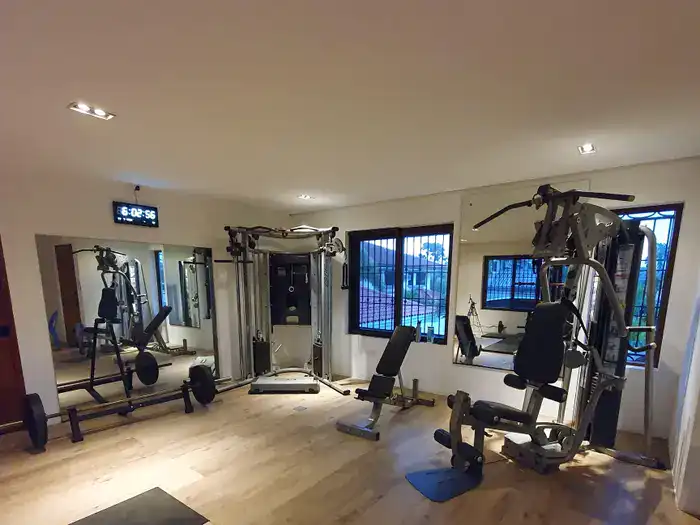
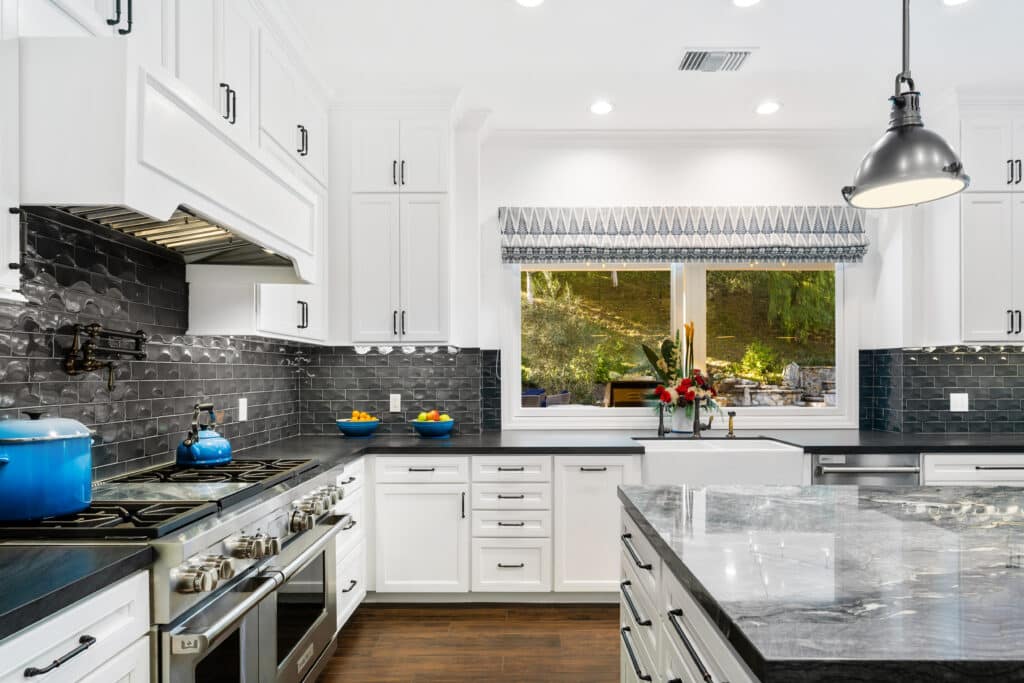
We recommend engineered hardwood with a thick wear layer or stone polymer core luxury vinyl plank for open floor plans in Calabasas to ensure continuous sightlines and dimensional stability across large room spans. High thermal exposure from expansive glass doors and sudden relative humidity drops demand stable flooring materials paired with rigorous subfloor vapor barriers and acoustic underlayments.
In our remodeling practice across Sherman Oaks, Calabasas, and surrounding San Fernando Valley communities, we routinely witness how improper material selection destroys the visual flow of open layouts. When a floor abruptly transitions between cooking, dining, and living zones, sightlines fragment and mechanical transition strips introduce unwanted trip hazards. Continuous flooring preserves expansive architectural proportions, elevates lighting reflection, and creates an effortless indoor-outdoor transition.
However, installing a single continuous surface across 1,000 square feet or more exposes materials to intense climate and structural variables. Subfloor moisture vapor emissions, differential settling across foundation types, and extreme thermal spikes require technical specification rather than mere aesthetic preference. We have compiled this comprehensive guide to help homeowners navigate material engineering, acoustic performance, and local environmental resilience.
Table of Contents
Key Takeaways for Open Layout Flooring
Selecting flooring for open layouts in Calabasas requires unifying surface materials across functional zones, managing dramatic relative humidity swings, and mitigating thermal exposure from large window walls. Proper execution relies on zero-transition installations, high-density core materials, continuous subfloor leveling, and specialized sound-dampening underlayments rated at Impact Insulation Class 60 or higher.
- Continuous flooring materials eliminate abrupt threshold transitions, preserving long sightlines and removing physical trip hazards across high-traffic pathways.
- Microclimate conditions in the foothill regions trigger indoor relative humidity drops below 20 percent during Santa Ana wind events, requiring high dimensional stability.
- Engineered hardwood with at least a 3-millimeter wear layer and Stone Polymer Core (SPC) luxury vinyl plank represent the most reliable structural options.
- Comprehensive subfloor leveling within 1/8-inch variance over 10 feet prevents hollow footsteps, seam tension, and surface telegraphing across wide footprints.
- High Impact Insulation Class (IIC) underlayments and acoustic elastomeric adhesives are mandatory to dampen sound reverberation in open, high-ceiling spaces.
Microclimate Pressures and Architectural Dynamics in Calabasas
Calabasas microclimates create severe indoor relative humidity fluctuations and direct thermal loads that threaten wide-span flooring stability across open-concept layouts. Dramatic moisture drops during Santa Ana wind events and intense solar radiation through multi-slide glass doors generate expansion and contraction stresses that easily buckle poorly specified materials.
Residential architecture in Calabasas and neighboring communities like Encino and Tarzana heavily emphasizes open-concept designs featuring vaulted ceilings and floor-to-ceiling glass systems. While these architectural elements maximize natural light, they subject indoor floor surfaces to localized temperature spikes exceeding 105 degrees Fahrenheit. According to installation guidelines from the National Wood Flooring Association, natural wood materials require a constant relative humidity range between 30 percent and 50 percent to avoid severe cupping or crowning.
During fall and winter Santa Ana wind conditions, indoor humidity levels frequently drop below 20 percent when heating systems run continuously. In a massive, undivided footprint, cumulative plank shrinkage across 40 linear feet creates visible gap formation and edge separation. Furthermore, concrete slab foundations common in Southern California continuously emit ground moisture vapor that must be managed to protect organic flooring layers.
- Solar Thermal Spikes: Unshaded glass door assemblies elevate floor surface temperatures locally, causing thermal expansion in non-rigid materials.
- Rapid Humidity Drops: Low atmospheric humidity desiccates timber fibers, pulling moisture from plank structures and expanding seam gaps.
- Subfloor Vapor Migration: Concrete slabs on grade transmit ground moisture into the building envelope, requiring continuous vapor control.
Evaluating Top Flooring Materials for Open Concepts
Evaluating flooring for continuous open footprints requires balancing aesthetic longevity, moisture resistance, thermal stability, and underfoot comfort across cooking, dining, and living zones. Engineered hardwood, SPC luxury vinyl plank, large-format porcelain tile, and polished concrete each deliver distinct mechanical trade-offs under Southern California environmental pressures.
Engineered Hardwood
Engineered hardwood offers the ideal balance of natural wood luxury and cross-directional core stability for continuous open floor plans. Its multi-ply substrate resists humidity movement far better than solid timber, making it a premier choice for cohesive living and kitchen spaces.
We frequently specify engineered hardwood with a wear layer of 3 millimeters to 6 millimeters, which allows for future sanding and refinishing. This construction withstands moderate moisture shifts without the warping tendencies inherent to solid wood planks.
- Strengths: Increases long-term property appraisal equity, provides tactile warmth, and installs securely over conditioned concrete slabs.
- Considerations: Requires immediate cleanup of standing liquids in kitchen zones and necessitates jobsite climate acclimation prior to installation.
Luxury Vinyl Plank (SPC)
Stone Polymer Core luxury vinyl plank delivers total waterproof protection and exceptional dimensional stability across expansive, high-traffic open layouts. Its rigid composite core made of limestone dust and stabilizer polymers eliminates expansion risks caused by environmental humidity shifts or accidental kitchen spills.
In our client renovations throughout West Hills and Calabasas, SPC flooring excels in homes with pets, active families, or direct pool access. The dense core prevents surface telegraphing from minor subfloor imperfections while remaining completely impervious to water damage.
- Strengths: Completely waterproof, highly resistant to scratching, and cost-effective across large continuous floor areas.
- Considerations: Provides lower real estate valuation uplift than genuine hardwood and requires high-quality underlayment to avoid a hollow sound.
Porcelain Tile
Large-format porcelain tile creates a sleek, seamless surface that is completely immune to water, solar radiation, and scratches in wide open-concept spaces. When installed over unyielding subfloors, porcelain tile provides unmatched durability and acts as an efficient conductor for radiant floor heating systems.
Technical standards set by the Tile Council of North America require minimum 95 percent mortar coverage in exterior or wet areas and strict substrate flatness to prevent tile lippage on formats 24 inches or larger.
- Strengths: Completely fireproof, water-impervious, UV-stable behind multi-slide glass doors, and extremely durable under heavy foot traffic.
- Considerations: Cold and hard underfoot during long standing periods, amplifies room reverberation, and requires intensive subfloor prep.
Polished Concrete
Polished concrete converts existing structural concrete slabs into a continuous, industrial-style floor plane that offers total resistance to thermal stress and moisture. This floor system eliminates material seams entirely, making it ideal for modern, minimalist open layouts with high foot traffic.
While polished concrete provides an indestructible finish, it demands careful evaluation of the underlying slab for structural micro-cracks. We utilize specialized lithium silicate densifiers and diamond grinding pads to produce a stain-resistant, highly reflective surface finish.
- Strengths: Extremely durable, maintenance-free, completely immune to water damage, and highly effective for passive solar mass design.
- Considerations: Rigid feel underfoot, zero acoustic absorption, and prone to showing telegraphing structural slab stress cracks over time.
Decision Framework and Trade-Off Analysis
Selecting the right flooring material involves navigating conditional trade-offs between water exposure, thermal loads, sound insulation, and investment capital across open footprints. If kitchen wet zones integrate seamlessly into living spaces, prioritize waterproof SPC vinyl or engineered hardwood paired with localized moisture protection membranes.
Our decision matrix relies on conditional logic based on client lifestyle priorities and structural conditions. If your space features floor-to-ceiling unshaded southern glass exposure, select porcelain tile or low-expansion SPC vinyl over natural wood materials. If acoustic comfort and resale value dominate your project requirements, prioritize thick-veneer engineered hardwood installed over sound-dampening elastomeric membranes.
Common failure modes in open floor plans stem from mixing incompatible floor heights or ignoring expansion joint requirements across long spans. Failure to account for perimeter relief gaps leads to surface tenting, while inadequate subfloor leveling results in seam separation within two years of installation.
Technical Material Specification Comparison
Comparing technical parameters enables homeowners to evaluate material suitability based on structural thickness, density, acoustic ratings, subfloor criteria, and total installed costs. The following table details performance metrics across primary flooring categories for open layout installations in Southern California, with values expressed in US dollars per square foot.
| Flooring Material | Thickness Range | Wear Layer / Core Density | Thermal Stability | Acoustic Rating (IIC Range) | Subfloor Flatness Tolerance | Installed Cost Range (USD per sq ft) |
|---|---|---|---|---|---|---|
| Engineered Hardwood | 1/2 inch to 3/4 inch | 3 mm to 6 mm Wood Veneer | High | IIC 58 to 65 | 3/16 inch per 10 feet | 12 to 24 USD |
| SPC Luxury Vinyl Plank | 5 mm to 8 mm | 20 mil to 30 mil Wear Layer | Exceptional | IIC 62 to 72 | 3/16 inch per 10 feet | 6 to 12 USD |
| Large-Format Porcelain Tile | 3/8 inch to 1/2 inch | Fully Vitrified Porcelain | Exceptional | IIC 45 to 52 | 1/8 inch per 10 feet | 14 to 28 USD |
| Polished Concrete | Slab Surface Treatment | 3000+ PSI Compressive | Exceptional | IIC 40 to 45 | Slab Dependent | 7 to 15 USD |
Practical Case Studies: Overcoming Complex Open-Plan Challenges
Executing seamless flooring across complex open floor plans often demands custom engineering solutions to resolve mismatched subfloors and extreme thermal expansion stresses. Our field experience in Calabasas demonstrates how proper diagnostic testing and specialized preparation techniques eliminate structural failure risks in demanding residential environments.
Case Study 1: Multi-Subfloor Leveling and Vapor Mitigation in Calabasas Highlands
Resolving a multi-subfloor transition between a concrete slab kitchen and a raised wooden joist living room required active moisture barrier application and precision self-leveling across 1,400 square feet. By bridging structural subfloor materials seamlessly, we installed continuous wide-plank hardwood without installing disruptive transition moldings between functional living zones.
During initial site evaluation, calcium chloride testing indicated moisture vapor emissions of 7.8 pounds per 1,000 square feet over 24 hours on the slab portion. This moisture reading exceeded standard adhesive tolerances, creating a high risk of wood delamination.
- Applied a two-part epoxy moisture mitigation membrane directly to the concrete slab to suppress vapor transmission below 3 pounds per 1,000 square feet.
- Fastened a cementitious backer assembly over the plywood subfloor section to unify elevation and structural deflection across the joists.
- Poured high-compressive-strength self-leveling underlayment feathered over a 12-foot transition zone to eliminate subfloor height variance.
- Glued down a continuous 7.5-inch wide-plank European oak engineered hardwood across the entire 1,400-square-foot open room.
Case Study 2: Managing Thermal Expansion Across a 48-Foot Linear Span
Mitigating thermal expansion across a 48-foot continuous flooring run exposed to direct solar radiation through South-facing glass doors required strategic expansion engineering. By specifying low-expansion composite materials and concealed perimeter relief gaps, we prevented floor tenting without breaking visual continuity across the open floor plan.
Peak summer surface temperature readings behind the unshaded multi-slide glass doors measured 108 degrees Fahrenheit. Standard floating floor products expand rapidly under this thermal stress, leading to mid-room buckling if perimeter relief is insufficient.
- Specified high-density Stone Polymer Core luxury vinyl plank with an ultra-low expansion coefficient rated below 0.05 percent.
- Milled custom 5/8-inch perimeter expansion channels behind all baseboard runs, door jambs, and kitchen island cabinetry.
- Applied heavy-duty acoustic adhesive under the direct solar focal zone to lock planks in place while allowing perimeter float.
- Recommended solar-control ceramic window films to reduce surface heat spikes by up to 18 degrees Fahrenheit during summer months.
Acoustic Optimization for Wide Open Spaces
Acoustic optimization in open-concept homes requires dampening sound wave reflections off expansive hard surfaces to maintain comfortable conversational acoustics. Combining high Impact Insulation Class underlayments, sound-dampening adhesives, and soft architectural textiles effectively prevents echo and impact noise transfer between adjoining open spaces.
In high-ceiling homes across Agoura Hills and Calabasas, footstep impact noise and ambient echo degrade indoor comfort when interior walls are absent. Hard surface materials reflect high-frequency sound waves, multiplying noise levels throughout the main living areas.
- Acoustic Underlayments: Installing high-density rubber or recycled felt underlayment rated at IIC 65 or higher isolates footfall impact vibration from the structural subfloor.
- Direct-Glue Sound Membranes: Utilizing elastomeric adhesives for glue-down engineered wood installations creates a permanently flexible, sound-absorbing cushion beneath every plank.
- Strategic Rug Zoning: Placing thick wool area rugs and upholstered furniture within seating areas breaks up acoustic reflection paths while visually anchoring distinct room functions.
Professional Subfloor Preparation and Acclimation Guidelines
Achieving a flawless, long-lasting open floor plan installation requires strict adherence to subfloor flatness standards, comprehensive moisture testing, and controlled climate acclimation. Neglecting these essential mechanical preparation steps leads directly to hollow sounds, plank gapping, adhesive failure, and premature surface degradation across broad floor spans.
Before delivering natural wood materials to the jobsite, the home’s HVAC system must operate continuously for at least five days. Ambient conditions must remain strictly within 65 to 75 degrees Fahrenheit and 35 to 50 percent relative humidity.
Subfloor flatness must meet stringent tolerances of 3/16-inch variance over a 10-foot radius or 1/8-inch over 6 feet. We mechanically grind down concrete high spots and fill low depressions using fiber-reinforced cementitious leveling compounds prior to laying floor materials.
Frequently Asked Questions
Can engineered hardwood be installed continuously into an open-concept kitchen?
Yes, engineered hardwood can be installed continuously into open-concept kitchens when sealed with a durable polyurethane factory finish and maintained properly. Its multi-ply dimensional core minimizes moisture-induced expansion, creating a seamless visual flow between cooking and living areas. Spills must be wiped up promptly to prevent water from penetrating edge seams. Choosing wire-brushed textures also helps conceal minor wear in high-traffic kitchen work triangles.
How do Santa Ana winds impact natural wood flooring in Calabasas open layouts?
Santa Ana winds drop indoor relative humidity levels below 20 percent, causing natural wood fibers to release moisture and shrink rapidly. This sudden desiccation manifests as temporary micro-gapping between floorboards across expansive open room runs. Installing engineered hardwood with a stable plywood core mitigates this movement significantly compared to solid timber. Homeowners should also utilize HVAC humidification systems to maintain indoor humidity between 30 and 50 percent during dry wind events.
What wear layer thickness is required for luxury vinyl plank in high-traffic open spaces?
A minimum wear layer thickness of 20 mil or 0.5 millimeters is required for luxury vinyl plank in high-traffic open floor plans. This commercial-grade wear layer provides superior protection against scratches from pet claws, furniture movement, and heavy foot traffic across undivided spaces. For extreme durability or heavy household activity, selecting a 30-mil wear layer with a polyurethane ceramic bead coating delivers maximum longevity. High wear layers also prevent pattern fading in areas with strong sun exposure.
How are expansion gaps hidden across continuous flooring spans exceeding 40 feet?
Expansion gaps across large continuous spans are hidden beneath baseboards, door casings, floating cabinetry, and shoe moldings around the room perimeter. Continuous spans exceeding 40 linear feet require calculated 1/2-inch to 5/8-inch relief gaps along all wall boundaries to absorb thermal movement. By avoiding middle-of-the-room transition strips, the floor maintains a completely seamless appearance. Strategic placement of expansion zones under kitchen island toe-kicks also accommodates plank expansion invisibly.
Is porcelain tile or engineered hardwood better over radiant subfloor heating systems?
Porcelain tile is superior over radiant subfloor heating because of its high thermal conductivity and zero risk of heat-induced structural warping. Tile transfers radiant heat rapidly into the living space and retains thermal energy efficiently without expanding or degrading. Engineered hardwood approved for radiant heating also performs well, provided surface temperatures do not exceed 85 degrees Fahrenheit. However, tile provides better thermal output and long-term stability over heated hydronic or electrical subfloor elements.
Sources
- National Wood Flooring Association (NWFA) Installation Guidelines and Moisture Standards: https://nwfa.org
- Tile Council of North America (TCNA) Handbook for Ceramic, Glass, and Stone Tile Installation: https://tcnatile.com
- City of Calabasas Environmental and Climate Profile: https://en.wikipedia.org/wiki/Calabasas,_California